Caffeinated ideas and views on marketing communications

Deborah Brody

Deborah Brody writes and edits anything related to marketing communications. Most blog posts are written under the influence of caffeine.

Making blogging easier

The reason I created the How to Write Your Blog workshop–which I just presented on Tuesday at the Silver Spring Civic Center–is because I have spoken to many people who think blogging is hard or that it takes to much time. I have found blogging to be fun, and wanted to teach people that it doesn’t have to overwhelming.

The workshop leads you through reasons to blog to writing a blog post. We discuss keywords, categories, tags and headlines. We discuss what you should and should not do on a blog. And what most participants find helpful is the part on generating blog post ideas.

Out of the three hours allotted to the workshop, we spend 20 minutes writing a blog post.  The idea is that when you realize you can write a whole post in 20 minutes, it seems doable and perhaps even easy.

One of the participants said that breaking up the process into its parts makes it seem less stressful, and that is exactly the point.

My colleague Lisa Newman took photographs of the workshop and created this montage:

If you missed the workshop this time around, you may want to sign up for my enewsletter so that you can find out when it’s being offered again.

About Deborah Brody

Deborah Brody writes and edits anything related to marketing communications. Most blog posts are written under the influence of caffeine.

Share

Pepco does have a communications strategy: go on the offense

Yesterday, I wrote about Pepco’s latest print ad, where they find customers who think Pepco does really well. And today, in the Washington Post, there’s an article entitled “Pepco defends its response to derecho storm, saying it “mobilized quickly.”The article makes clear that Pepco wants to change the perception that it responded slowly and badly. It says:

Pepco vigorously defended itself Monday in its first self-assessments since last month’s derecho storm, saying it responded aggressively and effectively to restore power to nearly half a million customers left sweltering in the dark. The electric company accepted limited responsibility for software glitches that affected tens of thousands of calls for service and for its inability to give customers a better sense of when their power would be restored.

Apparently, Pepco has decided that its communication strategy is to aggressively tamp down on any criticism of its service. What a contrast from Verizon, which today has a letter to the editor in the Washington Post where it apologizes for disruptions to 911 calling that occurred in the aftermath of the derecho.

The problem with Pepco’s communication strategy is that, as I have pointed out before, it doesn’t acknowledge reality. In this case, the reality  is customers were rightfully frustrated.  By not recognizing genuine complaints, the company is effectively hedging against doing anything to fix those problems.

What do you think? Does this strategy work for Pepco, or does it further deteriorate its public image?

About Deborah Brody

Deborah Brody writes and edits anything related to marketing communications. Most blog posts are written under the influence of caffeine.

Share

Pepco really really wants you to believe a story

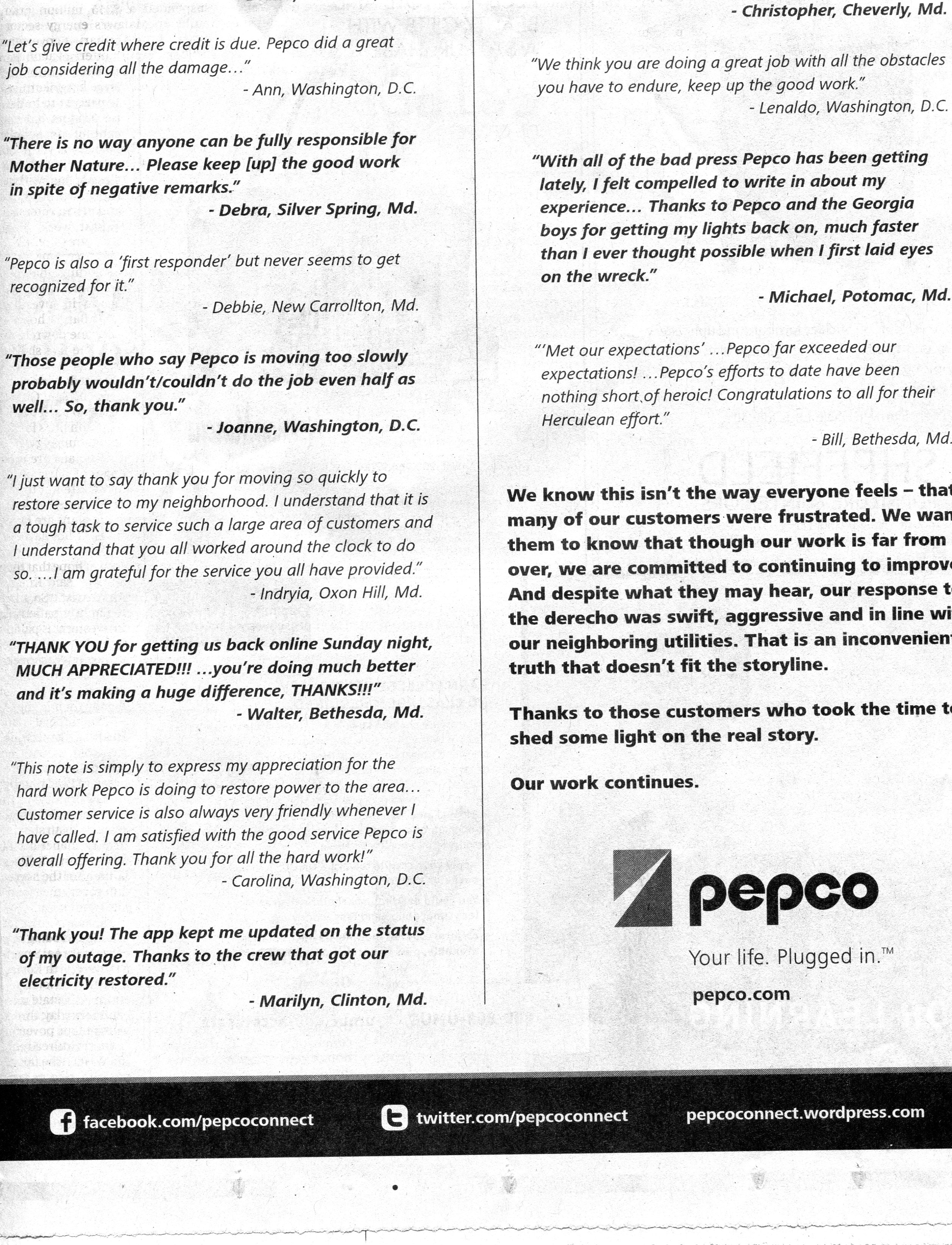
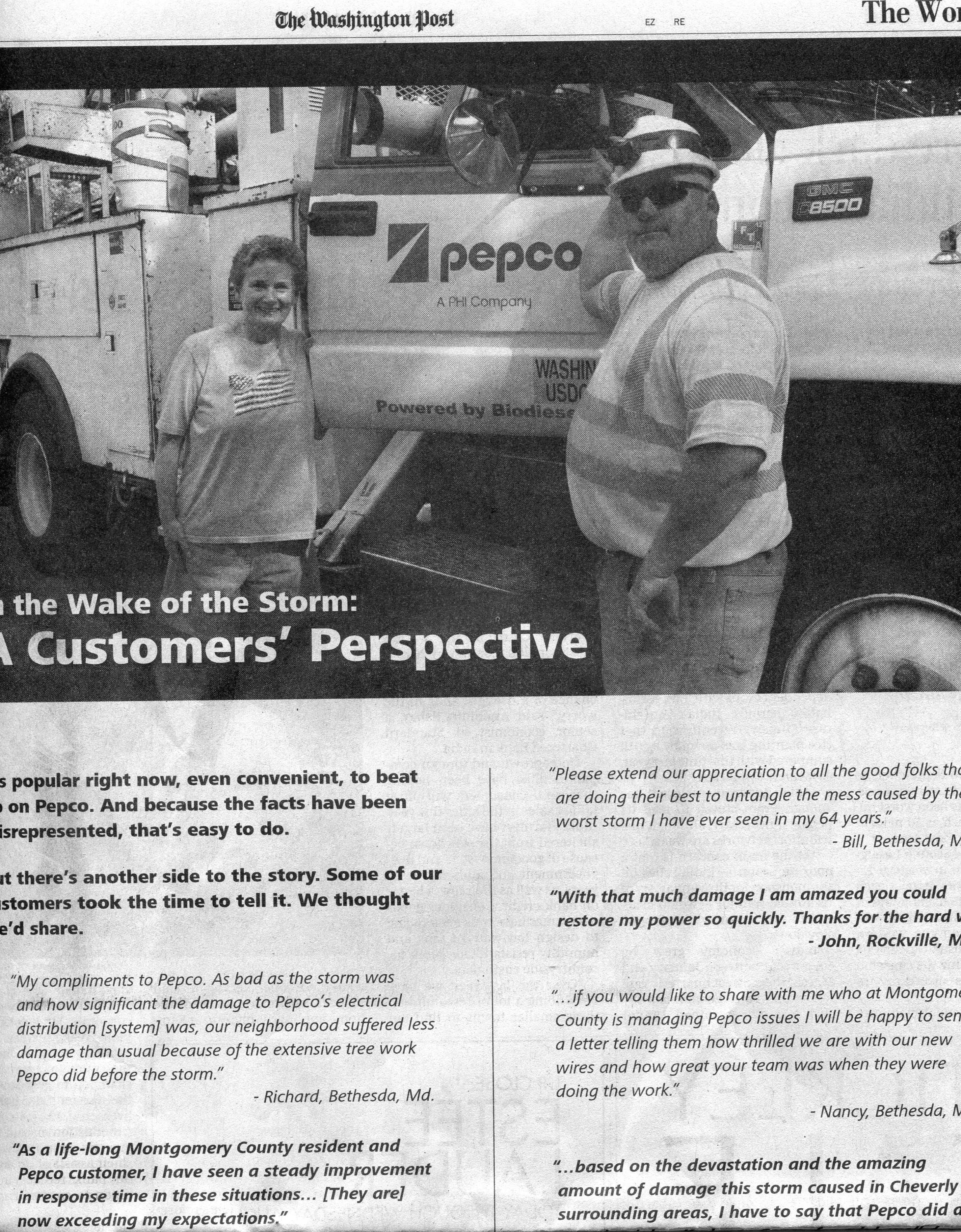
Well, faithful blog readers, I thought I was done writing about Pepco’s advertising efforts, but then I saw this nearly-full page ad in yesterday’s (Sunday, July 29) Washington Post (again, I had to scan it in two parts):

In case you can’t read the ad above, let me provide the content:

It’s popular right now, even convenient, to beat up on Pepco. And because the facts have been misrepresented, that’s easy to do.

But there’s another side of the story. Some of our customers too the time to tell it. We thought we’d share.

If I understand this correctly,  Pepco is saying that government officials like Rep. Chris Van Hollen, the Montgomery County Council, DC Mayor Gray,  the media, and customers who are complaining about Pepco’s dismal service are “beating up” on Pepco because the “facts have been misrepresented.” What facts is the ad alluding to? We know (we lived) the facts: 780,000 of Pepco’s customers lost power, and of those, most received power by July 4, five days after the storm. Other customers weren’t restored until July 6. Those are the facts on the ground and they have not been misrepresented.

Pepco is attempting to convince you that you are wrong if you believe the narrative that Pepco did not do enough to restore power during the derecho (which was exactly one month ago from the date of the ad). Instead, Pepco parades 17 customer testimonials  that are praising Pepco’s performance (out of the 780,000 affected by the outage—that is an extremely meager 0.00217%).

The ad continues:

We know this isn’t the way everyone feels-that many of our customers were frustrated. We want them to know that though our work is far from over, we are committee to continuing to improve. And despite what they may hear, our response to the derecho was swift, aggressive and in line with our neighboring utilities. That is an inconvenient truth that doesn’t fit the storyline.

Thanks to the customers who took the time to shed some light on the real story.

So, Pepco is saying that it knows “some” customers are frustrated, but in essence, they have no right to feel that way because it doesn’t fit the Pepco storyline. The Pepco storyline (and that is exactly what it is, a story that Pepco tells itself) is that Pepco works hard and that people have no right to expect anything more from it. The 17 customers that they quote  in the ad understand this “real story.”

Honestly,  in my nearly 20-year marketing career, I have never seen something like this.  It truly is a waste of advertising dollars (which Pepco customers are footing the bill for).  To run an ad in the newspaper of record to tell customers that they are wrong to feel frustrated because they are being misguided by “misrepresented facts” is truly an outrage.

Again, Pepco’s communications department seems to be tone-deaf, and really really bad at advertising. Rule number one of advertising is that you don’t insult your customers.

Pepco management is desperate to improve its public perception. However, through these misguided and mismanaged advertising efforts, it is only hurting itself further.


About Deborah Brody

Deborah Brody writes and edits anything related to marketing communications. Most blog posts are written under the influence of caffeine.

Share

How do you figure out what to write about?

Many people like the idea of blogging, but are stymied when actually wanting to start writing. What to write about? How to write it? What if no one reads it? If this is you–and you live in the Metro DC area–come to a workshop I am leading next Tuesday, July 31 in Silver Spring. I will teach you how to write your blog. You will leave the session with several blog post ideas, a completely written blog post, and lots of information to get you blogging.

All the details and registration are available here:

http://learntowriteyourblog.eventbrite.com/

I hope to see you Tuesday! If you can’t make it next week, and you are interested in the workshop, please drop me a line or a comment.

About Deborah Brody

Deborah Brody writes and edits anything related to marketing communications. Most blog posts are written under the influence of caffeine.

Share

Pepco doesn’t understand public relations

I think I finally figured out why Pepco has such a bad image: the company does not “get” public relations. The company seems to believe that advertising alone can build a positive image, while failing to realize that most people differentiate between bought advertising and the third-party endorsement that comes from a public relations program.

If we look at the past month, we have not seen a single positive sign from Pepco. The latest news, out today, is that Pepco is complaining that the reduced rate hike that it is getting from the Maryland Public Service Commission won’t be enough to sustain “improvements.” Read the article in the Washington Post here.What we have seen is a large advertising campaign designed to tell people that Pepco responded well to the derecho storm (in spite of ample evidence to the contrary).

Pepco  understands that it must have a spokesperson to answer questions, but it does not seem to get that the spokesperson must tell the truth and not minimize the suffering caused by prolonged power outages (which is exactly what Thomas Graham continuously does). As Robert McCartney, columnist for the Washington Post puts it: “A slip of tongue reveals Pepco’s contempt for its customers.”

Public relations, according to BusinessDictionary.com, is the practice of creating and maintaining goodwill among an organization’s publics, through the use of such tactics as media relations, sponsorships and charitable contributions.

As far as I can see, Pepco is not doing a good job at creating or maintaining goodwill. It is failing at public relations (and in my opinion, it is also failing at advertising). More troubling is that the company seems to not care what the public thinks. It seems to believe that if it places enough advertising, the public will believe that it is working hard and improving reliability. As I have said before, the public will only believe that Pepco is working hard– at advertising– unless changes are made that affect them directly (better communication, faster restoration times, indeed, increased reliability).

Pepco–how about you hire someone who “gets” public relations? Perhaps with some wise PR counsel you will improve your image by actually making steps that do increase goodwill.

UPDATE

Tom Graham has this letter to the editor in Wednesday’s Washington Post.  I quote:

Critics can say many things about the company and about me, but to question our care and concern for our customers is simply unfair. This is my home, these are my people, and they are — and will remain — my utmost professional priority.

Do you think this rings true? Is the charge unfair?  Moreover, do you think this was a good move on Graham’s part?


About Deborah Brody

Deborah Brody writes and edits anything related to marketing communications. Most blog posts are written under the influence of caffeine.

Share

Knowing the problem is not enough

The other day I had a conversation with a neighbor. She’s renovating her house and she mentioned that one of her big problems is mildew. I asked whether she has a dehumidifier. And, you guessed it, she does not. If you have humidity, which leads to mildew, then do something about it.

There are many people out there who know exactly what the problem is, but many of them don’t find a solution. I am sure you have experience with this situation. For instance, how many people have you met who complain of having headaches or stomach issues or fatigue (and I mean on an ongoing basis), yet don’t go to the doctor?

How many companies or organizations know they have a customer communications problem, yet don’t update their website, survey their members, create a new brochure, train front line employees or whatever it takes to remedy the situation?

Awareness is important, but action is the only way to move forward.

About Deborah Brody

Deborah Brody writes and edits anything related to marketing communications. Most blog posts are written under the influence of caffeine.

Share

Dominion vs. Pepco: How ads reflect corporate culture

Last week, I wrote about an ad campaign Pepco is currently running (there have been at least two or three more of the same ad I mentioned) in the Washington Post.  Today, I noticed a full page ad on the back page of Section A in the Post, by Dominion Power (which services parts of Virginia and which had a million or so customers without power).

Because of the size of Dominion’s ad, here it is scanned in  two parts:


Notice anything? Dominion ACKNOWLEDGES the problem, and focuses on their customers. There is no apology here either, but there is a more human touch to this ad than Pepco’s. Both Pepco and Dominion say the same thing — the storm was devastating and the circumstances were challenging–but with different sentiment.

I believe that all marketing communications reflect a company’s corporate culture. Some companies are more formal, some are more humane and some are more playful or fun. Some companies–think law firms–are all about formality and adherence to strict protocols. These companies will usually have dress codes and rigid standards of conduct. Their advertising/communications will also be formal and rigid. Other companies–think entertainment–are more relaxed. Their advertising is generally more creative.

WTOP (news radio here in Washington) hosted an incredible session last week with eight utility executives. Each company had suffered power losses from the derecho storm. They all said similar things–the storm was unexpected, they weren’t prepared, tree trimming would not have helped since whole trees came down and burying power lines is very expensive. What was different amongst them was the tone. Dominion’s executive said almost the same thing Pepco’s Tom Graham said, but he said it without the condescension. He acknowledged how hard it was for the customers–Graham was concerned with his talking point (“reliability”) and with making excuses.

You can see the difference in corporate culture in Pepco’s advertising versus Dominion’s. Dominion is more down to earth, whereas Pepco doesn’t seem to understand that “customers” are people.  Pepco is more formal, more wordy. Dominion was inclusive (“Storms can tear things apart, but they can also bring us together) while Pepco was divisive (We were tested and we responded). For Dominion, there’s an attempt at solidarity with customers.

What do you think? Do you think these ads reflect different corporate cultures and priorities?

About Deborah Brody

Deborah Brody writes and edits anything related to marketing communications. Most blog posts are written under the influence of caffeine.

Share

Pepco truly believes advertising is the answer

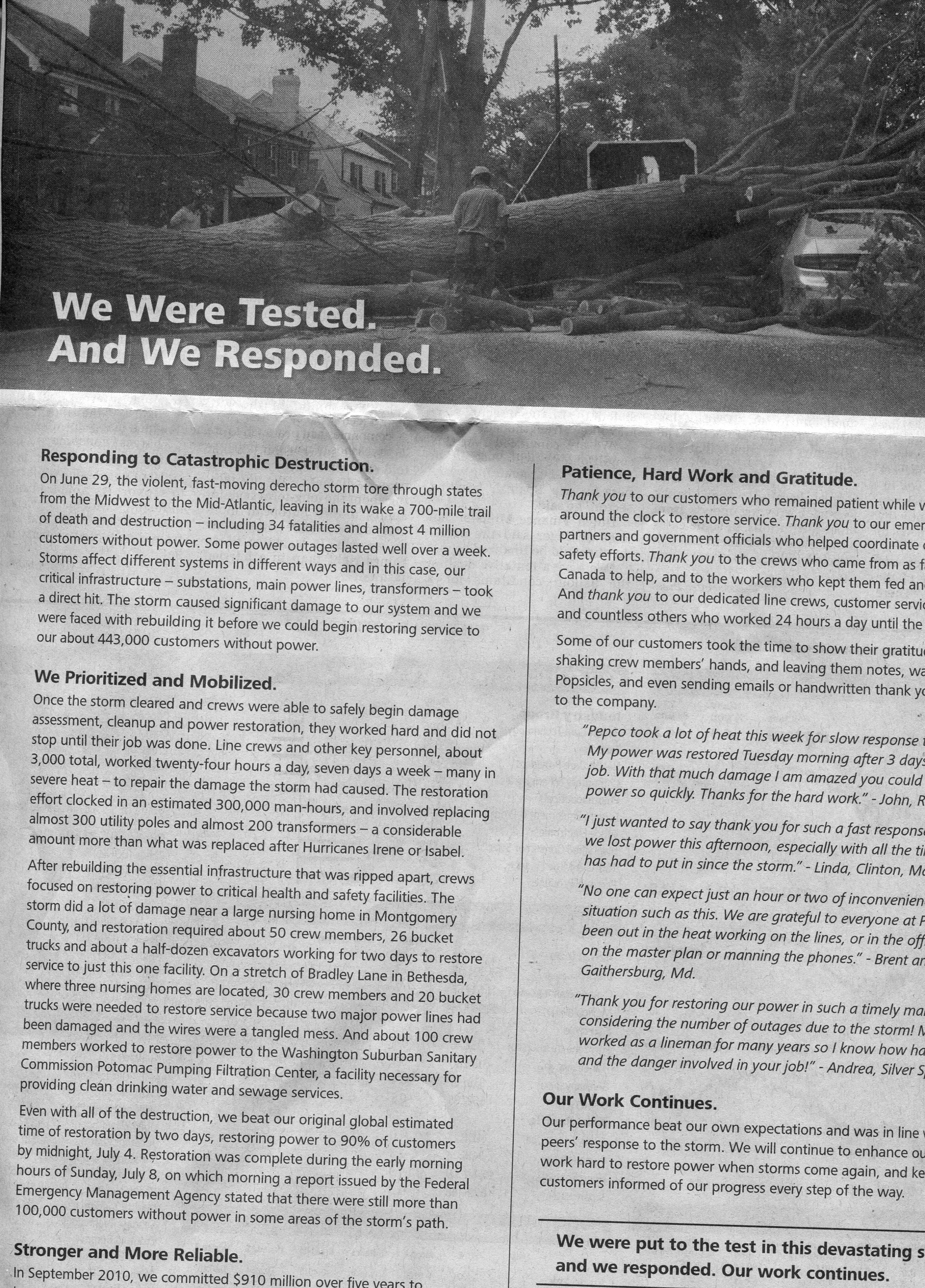
After eight or more days, Pepco finally restored power to everyone that had lost it. And the company finally got back  to advertising how hard it is working to be reliable. This morning, I came across a three-quarter page ad in the Washington Post. It was too large for my scanner to make the whole thing into a PDF but here is the portion I was able to scan:
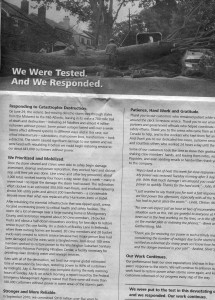
Notice the headline: We Were Tested. And We Responded.

In the ad, Pepco claims it prioritized and mobilized crews. The ad says: “Even with all the destruction, we beat our original global estimated time of restoration by two days…”

Apparently, this ad is designed to convince customers that Pepco not only did what it is meant to do (provide power) but was able to restore power much quicker than it promised. (By the way, this is an old sales trick: tell the customer that you won’t be able to do something until a certain date, and then deliver early, making yourself look good.)  As if this is any consolation to the thousands of people who spent the last week trying to deal with excessive heat, throwing out spoiled food and spending out-of-pocket to stay in hotels and eat in restaurants.

The ad also says “We are stronger and more reliable-but no amount of strengthening to our system could have withstood a  storm of this magnitude.”

What Pepco is doing with that sentence is making excuses. I don’t think people were as upset with the initial loss of power from “a storm of this magnitude” but with how long it took power to be restored, coupled with completely abysmal communications.

Oh but this ad is not all about chest-thumping. No. It is also to say “Thank you to our customers who remained patient while we worked around the clock to restore service.” And also to thank its partners, employees, and indeed itself for “performance that beat our own expectation and was in line with our peers’ response to the storm.”

Pepco concludes that it will continue to “enhance our reliability, work hard to restore power when storms come again, and keep our customers informed of our progress every step of the way.”

Wow. Just wow.

Imagine if Pepco had engaged in some community and public relations work instead. For example, Pepco could have sponsored some cooling centers or handed out water and ice. Or what if the company sounded genuinely sorry for the situation its customers were facing? Instead, it seems that Pepco believes that if it tells people what it wants them to believe, then those people will simply believe it.

And again Pepco forgets that people have first-hand experiences to guide their decisions. Most people who called Pepco to report outages or get updates got no information or the wrong information. People who were able to access the Pepco website also were unable to get information. And then there is the reality that most people that lost power waited for at least two to five days to get it back. And that those days were during an almost unprecedented heat wave.

I am not sure who handles communications at Pepco, or who thought that making excuses and spinning the situation is a way to get customers on your side, but that person or persons should perhaps take a break from doing advertising. Advertising, especially something so unapologetic and self-serving as this particular ad is, is not the solution to fixing Pepco’s image.

Pepco is spending millions of dollars on advertising to rehabilitate its image and it is not working.  Every dollar more that goes into advertising, especially something like the ad above, is actually proving how out of touch this company is, how little it understands its customers and how even less it seems to care.

If you felt the need to run advertising, why not run an ad that said something simple like:

Thanks to our customers for your patience. Thanks to our staff for your hard work.

or

We are happy that power has been restored to all our customers, and we sincerely regret the major inconvenience. We promise to do better.

But no, we won’t see any humility or apologies from Pepco. Instead, we will see it ask for rate increases and blame everything from God to the weather for its inability to communicate properly and work efficiently.


About Deborah Brody

Deborah Brody writes and edits anything related to marketing communications. Most blog posts are written under the influence of caffeine.

Share

Working hard or hardly working? Pepco strikes again

Maryland, Virginia and DC were hit hard last Friday night by a storm called a Derecho. It came straight at us with winds clocked at 70 miles per hour, lightning and rain, all which brought down branches and even whole trees.  My house shook, the lights flickered, and then the power went out. I got out flashlight and immediately called Pepco. The initial message said crews were being assigned and I should have power restored by midnight. When I called the next 15 times, I got the same message each time: Crews would be assigned shortly.

Meanwhile, a million electric customers in the region were also without power, also not getting answers from their utilities. Intersections were dark and tempers were frayed–because not only was there no power, but record-breaking heat and humidity. I decamped to my local Cosi, which thankfully had power, coffee and free Wi-Fi. Pepco’s website informed me that the more than 1000 customers in my section did not have an estimated restoration time. By Sunday, after Pepco finished surveying the damage, it announced a “global estimated restoration time” of Friday, July 6 at 11 pm (yes, a whole week later).

Now, Pepco has been running an ad campaign for the past several months. Here’s a sample:

Notice the message: Pepco is working hard to improve its reliability.

But is Pepco doing enough? Is it reliable? After this fiasco, the answer seems to be no.

The commercial above makes claims that fly in the face of what happened on the ground. And what’s more, taking a week to restore power (during a heat wave), seems to me to indicate that Pepco is not working hard enough (or has enough crews, etc.).

Yesterday, Marc Fisher from the Washington Post called me because he had seen my previous blog posts on Pepco. He asked me what I would recommend that Pepco do, communications-wise. Should they not advertise? I am not sure what the answer is. I do know that a commercial like the one above does not ring true, and I will bet that the ad gets taken off the air. Perhaps the best course for Pepco is to invest its ad budget into infrastructure, and when it has made REAL, significant improvements, then have a PR campaign to inform its public about what exactly has been done. Just a thought.

Here’s Marc Fisher’s article, that ran today (I am quoted on the second page): For Pepco customers still without power, patience wears thin.

It seems that Pepco’s work still continues, and continues and continues. It is a long way from being what I would consider a reliable company.


About Deborah Brody

Deborah Brody writes and edits anything related to marketing communications. Most blog posts are written under the influence of caffeine.

Share

Want to learn how to blog?

It’s somewhat ironic, but I haven’t been blogging much this week because I have been working on the details for a blogging workshop!

If you or someone you know is in the Metro DC area and wants to learn how to more easily write blog posts, find topics and inspiration, make your headline more appealing and get your blog going, you may want to come to my “How to write your blog: A hands-on workshop.”

The workshop is taking place on Tuesday, July 31, starting at 9:30 a.m. at the Silver Spring Civic Center (which has plenty of parking nearby and is a few blocks from the Silver Spring Metro stop), in the Colesville Room.  The cost is $75 for the three hour session, (and will include refreshments).

You will leave the session with a ready-to-publish blog post, blog post ideas, lists of keywords and categories for your blog, and lots of other useful information that will make blogging easier for you.

If you have any questions, let me know in the comments.


About Deborah Brody

Deborah Brody writes and edits anything related to marketing communications. Most blog posts are written under the influence of caffeine.

Share
image_pdfimage_print

Contact us today to learn how to improve your marketing and communications.