Caffeinated ideas and views on marketing communications

Do you really want customer feedback? Ask the right way.

Lately, I have been inundated with customer feedback requests from what seems like every company with which I have even had a glancing blow. And all of these feedback requests have serious flaws.

Self-serving: The airline I flew wanted to know about my recent flight, but not about the other part of the same trip, which included one segment that was delayed five hours.

Bordering on harassment: My gym wants feedback (about what, I don’t know or care) and they have sent me at least five or more requests reminding me they want my feedback. Apparently they don’t take no for an answer.

Not interested in my opinion at all: The conference I attended last week says it wants my opinion, but sent a survey that focused more on my demographic profile than on my opinion.

Asking every possible question on earth: I got a questionnaire that I abandoned when I realized that after five minutes I was only twenty percent done, thanks to the helpful completion meter at the bottom of the survey.

Really, just give us a glowing review: Some companies send you a link to online customer response sites like Yelp, basically asking for you to provide a testimonial, and may even try to promote this action by offering a discount next time you come in.

Customer feedback can be very valuable. If done the right way, feedback requests can tell you what customers/clients/supporters are thinking, and can alert you to any issues. However, there’s a big “if” there, and as evidenced by my own examples above, many organizations are not handling these requests well.

Many times, I have provided specific feedback, only to never hear from the company again or see the problem addressed. I think the problem is that customer feedback requests straddle the line between communications/marketing and operations.

Communicators/marketers see asking for feedback as a way of communicating further with customers. Operations folks see feedback as a potential for improvement (theoretically). But if these two factions are not in consultation, you end up with customer feedback requests that don’t actually address any issues the customer may be having or may even hurt the brand as customers are bothered by repeated requests or intrusive questions.

Before you ask for customer feedback, here are four things to keep in mind.

  1. Determine exactly why you want feedback. Are you trying to assess your product/service? Are you trying to pinpoint problem areas? Do you want to get testimonials?
  2. Determine what you will do with the feedback. Will you address any issues?
  3. Determine the best way to get the feedback. Is it email? Or a phone call?
  4. Remember your customers are not obligated to give you feedback. Customers are in fact doing you a favor by providing feedback. Respect their time. Don’t harass them.

How do you handle customer feedback? Do you even ask for it? If you do, how do you go about it? Please let me know.


image_pdfimage_print

Give your website an oil change!

Your website and your car are more similar than you think. You put in a substantial investment up front when you acquired them, and you need to give them both maintenance if you want to keep them working properly.

Mechanics and car by Astrid Westvang via Flickr

Chances are good that if you want to keep your car running, you’ve spent some time and money giving it proper maintenance. But have you given any maintenance to your website since you launched it?

Manufacturers provide guidelines for car owners, making it easy to know when to do what. For example, most car owners are advised to give their vehicles an oil change approximately every 3,000 miles. You are also asked to take your car in for service at certain milestones (50,000 miles, etc.) to check out things like your brakes, hoses, and whatever else.

Depending on who developed your website, you may also have some guidance. However, there are many websites out there that haven’t gotten their figurative oil changes lately. It’s as if the website owners think that just putting up a website and forgetting about it is enough. Unfortunately, if you don’t give your website some maintenance, it will stop working properly for you.

Here are few things to check out on your website:

  • Is it mobile-friendly?
  • Is the contact information accurate?
  • Do you have social media properties? Are they included?
  • Are your links up to date?
  • Are all your pages rendering properly?
  • Is your content updated/accurate?
  • What is the copyright information (hint: if it says copyright 2009, you need to update)
  • If you list any personnel (staff, leadership, board), is the list complete and up to date?
  • If you list services or products, do you still offer all of these?
  • If you have pricing, is it accurate?
  • Is your website software up to date?
  • Is your domain registration in order?

This is not a comprehensive list. But if it’s been a while since you gave your website any thought or attention, you may want to put it on your to-do list. You may even find that maintenance is not enough and that you need a complete overhaul.

It’s no longer enough to just have a website. You must keep it up (or hire someone to do it for you).

What are your thoughts? When was the last time you took a look at your website?


image_pdfimage_print

My business card is not a pass to your enewsletter

This is a quick rant because I just received an enewsletter from a woman I met at an event two or three years ago. I haven’t heard from her since, but apparently she has just decided doing a newsletter is a good idea and that her list will include names from all the people from whom she has collected a business card. It didn’t help that the newsletter was addressed to “Brody,” not “Ms. Brody” or “Deborah.”

I immediately unsubscribed, not only because the last thing I need is another newsletter, but because this woman apparently thinks that my giving her my business card is an invitation to be added to a list. It does not. Business cards provide contact information, yes, but they do not have any power to agree to anything. I did not agree to be added to a list, and I certainly did not ask to be added to a list.

Here’s the thing: direct marketing that complies with the CAN-SPAM laws requires opt-in permission. Just having my business card in your possession is not permission to add me to your list.

The only way that having my business card gives you a pass to get me to be on your marketing list is if you use that contact information to get in touch with me first. For example, you might send me a personal, non-mass email asking me if I would be interested in your list, or perhaps asking me to visit your website where I would have the option to sign up for your newsletter, or you could call me (you know, on the phone) to set up a coffee date and talk to me.

A business card is a networking tool, nothing more. If you use the contact information on the business card to send me unsolicited material, then you are a spammer, plain and simple.

Rant over.

Thoughts?


image_pdfimage_print

Beware of the dog(ma)

You may have heard about the ongoing discussion in the public relations world regarding the usefulness of the press release. Many are saying the press release is dead.  Some are not so quick to give it last rites. Then there are those that are dogmatic about it: “always send a press release” or “never send a press release.”

Always and never are absolutes. To be dogmatic is to state a position unequivocally, to be absolute about it. The problem with dogma in communications is that nothing should be absolute. In the press release issue above, I would say that it depends: What is  the news, who is the target audience is and where do you want to communicate the news.

A definition of dogma

Here’s what my Webster’s dictionary says dogma is:

  1.  Something held as an established opinion, esp. an definitive authoritative tenet.
  2.  A doctrine or body of doctrines concerning faith or morals formally stated and authoritatively proclaimed by a church.

Notice what the two definitions have in common? The word authoritative, which is a synonym for official, conclusive, and dictatorial.

Examples of dogmatic communications thinking

Back when I started working in advertising, when I was a lowly media coordinator and my job was to place print media buys, I had a supervisor named Eileen. Eileen’s dogmatic belief about newspaper advertising was that you never place a print ad in Friday or Saturday newspapers. Never. (This was in the 1990s and people did not have the Internet. They read actual physical newspapers.)

But, back in the ’90s and even today, the entertainment/weekend section always came out on Friday.  I thought most people would get the Friday paper just for the entertainment section, to see what was going on, what movies were playing, etc., so I argued with Eileen that Friday was actually a great day to be in the paper. It was an uphill battle. Eileen had been taught, and believed with absolute certainty, that Friday was, in her words, a dog day for ads.

Recently, I had an online discussion with an website design firm that states it never uses WordPress for its clients because it is “always” more vulnerable to hacking. Instead, the firm always uses Adobe products. When presented with an alternative view (WordPress has open developing practices with thousands of plug-ins that increase functionality, for example) the design firm shot me down. It has a design dogma that disallows it from seeing the benefits of something alternative, or even using WordPress for some clients and Adobe for others, depending on needs.

In the blogging world, there seems to be a dogmatic belief that you must blog at minimum once a week and more is better. I have subscribed to this belief, but lately, I think it depends. I have seen blogs that I follow drop to blogging once a month with no ill effects (at least not visible….I don’t know if it affects their SEO).

Dogma may be necessary in religion. Faith requires absolute conviction. Communications, however, must be flexible. Things are constantly changing. Look at social media. Five years ago it was all Facebook and Twitter. Today, we have Medium and Tumblr and Pinterest and Instagram and on and on.

An alternative approach: use guidelines instead of tenets

You cannot afford to be dogmatic in communications. Always and never will leave you boxed in and unable to react to situations. A better approach is to create requirements and guidelines for your communications that take into consideration the why, what, where, who and how of what you are communicating.

Do you have a communications dogma? What is it? Please share.


image_pdfimage_print

The real problem with social media marketing

If you do a Google search on problems in social media marketing, you will find several articles that discuss the following:

  • Personnel (capacity of and/or lack of)
  • Strategy (generally lack of, or not fitting in with overall comms strategy)
  • No ability to measure ROI (or, can’t justify expenditure)
  • Budget (not enough)
  • Content (not adequate)
  • Consistency (generally, lack of)

[Go ahead. Google “the problem with social media marketing” and you will see for yourself.]

Although all these problems definitely affect the ability to do social media marketing, the biggest problem is this: all it takes is one click to unfollow/unlike.

In other words, it’s easy to lose support, and once you lose support, it’s very hard to gain it back.

It occurred to me this morning that although I recently unfollowed a couple big names in social media that I had not missed them in the very least. In fact, I was relieved to not see them in my timeline. In the personal realm, I have hidden several people on Facebook. Again, I don’t miss them and have almost forgotten them.

It’s easy to hit hide or mute or unfollow. And once you are out of sight, well, you are out of mind.

Still, because there’s a low barrier to entry, there’s also a low barrier to exit. Something can go viral one week and practically disappear the next week. People lurch from one topic to another. Some social media accounts get stale. Some social media accounts become offensive. Whatever the reason, we lose interest and we move on. And once we move on, it becomes difficult if not impossible to get us back.

There’s a small hitch to my theory and it’s social sharing. Say you unfollow “JoeBigMediaExpert” but your trusted colleague “Ilovesocialmedia” hasn’t. If “Ilovesocialmedia” constantly shares “JoeBigMediaExpert’s” posts, you’ll see them.

Still, the ease of ignoring (unfollowing/unliking) on social media plus the clutter issue (too much stuff!) is what any social marketer has to deal with. The guiding questions may be these:

  • What keeps followers interested?
  • What offends followers?
  • What’s the best way to bring value to followers?

What do you think?  What makes you keep following a brand or personality? What turns you off?


image_pdfimage_print

Best brew: 5 articles for your weekend reading

Get super-caffeinated, and read these five articles. A bit about punctuation, another bit about content, and some ideas for your blogs.

A Simple Formula for Writing Kick-Ass Blog Titles

10 punctuation essentials for every writer

7 Tips That Take Your Content from Flat to Fabulous

How Often Should Companies Blog?

Study: Only 57% of PR websites are mobile-friendly

Have a great weekend…and happy reading!

image_pdfimage_print

Are you seduced by the cheap and fast?

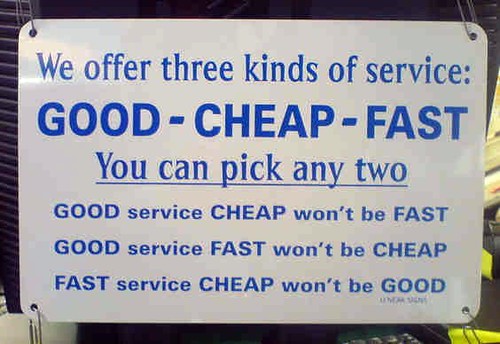
You can select only two of the following three types of service: good, cheap, fast.

Good - Cheap - Fast: Pick Any Two

It’s been making the rounds lately, although I first heard it from a graphic designer years ago. Basically, if you want something to be good and fast, it won’t be cheap. And if you want it to good and cheap, then it won’t be fast. And if you want cheap and fast, well then it surely won’t be good.

And yet, we are continually being sold cheap and fast. Every day there’s a new free tool to help you do something (as I wrote about a couple of weeks ago). Or you’ll find services being offered to do stuff fast (manage your social media in just minutes a day!).

Just yesterday, I saw something about how to make your own infographics quickly. This is because creating shareable infographics is a common digital marketing tactic. But not all infographics are shareable, mainly because they are not very good. Many times they don’t have enough information, or the right information, or they are not visually appealing. And other times they have too much information and are hard to understand. If digital marketers continue thinking all that is needed is an infographic, and that designing one can be done cheaply and quickly, then infographics will become useless if they haven’t already.

When you are going for the fast and cheap, you are focused on cost (time and money) instead of value (what you get for your time and money).

In times when budgets are tight and time is scarce, unless there’s a shift to focusing on value, people will continue to fall for the fast and cheap. And we know the fast and cheap may work in the very short term, but will rarely work to achieve long term business and communications goals.

What are your thoughts? Is there something that can be done fast and cheap and be worthwhile?


image_pdfimage_print

3 big reasons to avoid sarcasm in your business blog

A few weeks ago I came across a blog post with a headline that said something like “Why my business is getting off Facebook immediately.” Naturally, I was intrigued. But then I read the article, which told me the many reasons why it would be stupid for him or anybody to leave Facebook, saying things such as: Yes, I want to get off the fastest growing social network that has 800 million readers and counting.

The article, awash is sarcasm, was designed to make readers feel stupid for considering leaving Facebook.

I had been drawn in a headline that I didn’t realize was sarcastic until I read the blog post—a prime example of bait and switch. I felt angry and insulted that the author thought that anybody considering getting off Facebook was stupid.

And then last week, I came across this article on Ragan.com: 31 terms that will complicate your writing. The headline is not sarcastic, but the article is. However, the article is written pretty badly—I was confused as were many other readers as evidenced by the comments. The article, in my opinion, does not work at all.

I asked Brad Phillips, author of the Mr. Media Training blog, what he thought about using sarcasm in professional communication. Here’s what he said:

 The challenge is to make sure people don’t take a comment you meant sarcastically as a straightforward, more serious one. Therefore, I try to always either preface a sarcastic comment with an obviously absurd rhetorical question or put it in italics to make clear that it stands apart from the rest of the post.

Exactly. Your reader or audience has to understand you are being sarcastic. If not, there will be misunderstanding and in essence, a lack of communication.


When you decide to use sarcasm, you run three big risks:

1. You risk irritating or even alienating your reader

According to The Complete Idiot’s Guide to Clear Communication by Kris Cole, sarcasm inhibits communication: “Sarcasm in fact is in the same league as name-calling, ridiculing and shaming; and it leads to the same results.”

In intra-personal relationships, sarcasm can be extremely damaging. According to the post The Damage of Using Sarcasm in Workplace Communication by Skip Weisman:

There is no positive upside to using sarcasm. It offers only short-term positive impact for the sarcastic person whose ego may get a boost by putting others down in this manner.

Now, it will be couched in the context of humor and trying to be funny. Yet, that humor comes at the expense of someone else.

In essence, your sarcasm is a put-down to your audience, which can certainly lead to irritation and alienation.

2. You risk being misunderstood

Because sarcasm is a type of passive-aggressive communication — where you say one thing but mean another — there is a very good chance that your meaning will be misconstrued or lost.

It may be challenging for your readers to know that you are being sarcastic and as Brad Phillips said above, they may think you are being serious when in fact you are not.

Because sarcasm is often dependent on tone, and it is hard to express tone in writing, you will be forced to use devices like quotation marks or strike-throughs to make your meaning clear.

 3. Your risk seeming ethnocentric and culturally insensitive

Sarcasm does not travel well across cultures. While American culture tends to be very sarcastic, other cultures are not. And even within the U.S., there are regional differences. According to The Science of Sarcasm? Yeah, Right in Smithsonian Magazine:

Northerners also were more likely to think sarcasm was funny: 56 percent of Northerners found sarcasm humorous while only 35 percent of Southerners did. The New Yorkers and male students from either location were more likely to describe themselves as sarcastic.


Would you ever write a sarcastic white paper or case study? Probably not. Why? Because you think of white papers and case studies as serious documents, intended to share information and/or communicate a finding. Instinctively, we avoid sarcasm in “serious” communications. And many people don’t see blogging on the same level as other, more formal, writing.

The truth is that sarcasm is often used as a distancing technique, and it can be extremely corrosive to clear communication. You should avoid it in business blogging.

How do you feel about sarcasm in business blogging? Do you use it? Do you avoid it?

image_pdfimage_print

Are you lacking social media manners or best practices?

When I first started using Twitter in 2008,  I had no idea what an “RT” was or how to check “@” messages. I didn’t know Tweetdeck from Hootsuite. So I asked a couple millennial friends of mine, and over lunch, they explained how Twitter worked and how to use it.

Since then, I believe I have become fairly adept at using Twitter and use it quite heavily as a place to learn, share and interact with people. I’ve also used Twitter to promote my blog posts  and workshops, and by extension, my business.

One of the most gratifying aspects of Twitter is how many personal relationships I have developed. Some people whom I met through Twitter  have become friends IRL (“in real life”) and some have become trusted online colleagues.

Developing best practices for social media use

In order to make life on Twitter more manageable, I follow certain “best practices.”  Up to now, they’ve been in my head, but here’s a more formal list:

  • Use a client such as Hootsuite to make managing @ replies, streams easier
  • Group people in lists to include as a stream to follow (this way, I know what my friends/colleagues are up to)
  • Respond to @ replies ASAP
  • Thank people for sharing tweets, posts, etc.
  • Avoid obscenities/expletives and unfollow those who favor this type of communication
  • Follow selectively (and don’t follow back automatically)
  • Don’t engage with trolls, and block whenever possible
  • Block followers who are obviously spammers or bots or who are only following to get me to follow back
  • Be conscious of what I am sharing
  • Take personal conversations offline or DM if appropriate
  • Avoid unproductive complaining
  • Don’t tweet everything on my mind or share mundane stuff
  • Be personal without providing too much personal information
  • Don’t use tools that do your tweeting for you

To me, it’s about common sense and having manners

They say good manners exist so that your behavior make others comfortable. That’s why it is not good manners to use expletives (because some people may be offended and thus uncomfortable). That’s why we say please and thank you (because we want to acknowledge that we are not owed anything, and that we appreciate kind gestures). That’s why we don’t chew with our mouth open (no comment needed right?).

And yet, some people just don’t get that in order to be on social media, and get along with others, you need to mind your manners and your behavior. Perhaps they don’t really understand how Twitter works and that whatever you post on Twitter is visible to the public.  Perhaps they think you won’t notice if they ignore your messages. Perhaps they feel entitled.  Or perhaps they are always rude in person too.

Perhaps the best practice is to not take it personally

Who knows why people behave the way they do. Truth is you just don’t know. It could be they are going through a hard time or just got busy with other things. Some people like to offend and want to argue (trolls are everywhere on social media). Context and tone are hard to convey on social media, and on Twitter, you only have 140 characters to express yourself.

Do you have best practices for Twitter? Do you behave differently on different social networks?


image_pdfimage_print

The week’s best brew: super-caffeinated articles

As I type this, it is snowing outside (again). Let’s hope this is the last time this season! Spring starts this evening, at 6:45 p.m. and we are all ready for warmer temps and NO MORE SNOW! But I digress.

Following, you will find seven of the most interesting and/or useful  articles I have read and shared in the past couple of weeks. So pour yourself a nice cup of something brewed, and have fun reading!

On blogs and blogging:

3 Google Analytics Reports to Help You Find Blog Post Ideas Your Readers Will Love

The Anatomy of a Perfect Blog Post

How Well Do You Fact-Check Your Content

On writing and copy editing:

Like Versus As

12 Writing Exercises That Will Transform Your Copy Today

12 Useless Public Relations Terms

20 Embarrassing Phrases Even Smart People Misuse

Happy spring!


image_pdfimage_print

Contact us today to learn how to improve your marketing and communications.