Caffeinated ideas and views on marketing communications

Can you do advertising by algorithm?

You’ve seen advertising by algorithm every single time you go on Facebook. If you’ve done an online search for anything (books, movies, clothing, etc.), you will now see a banner ad for that thing or brand. If you’ve discussed anything with a recognizable name (politician, specific book or movie or brand) on your timeline, chances are you will see a sponsored post about that thing on your timeline. Those posts are automatically generated by algorithms.

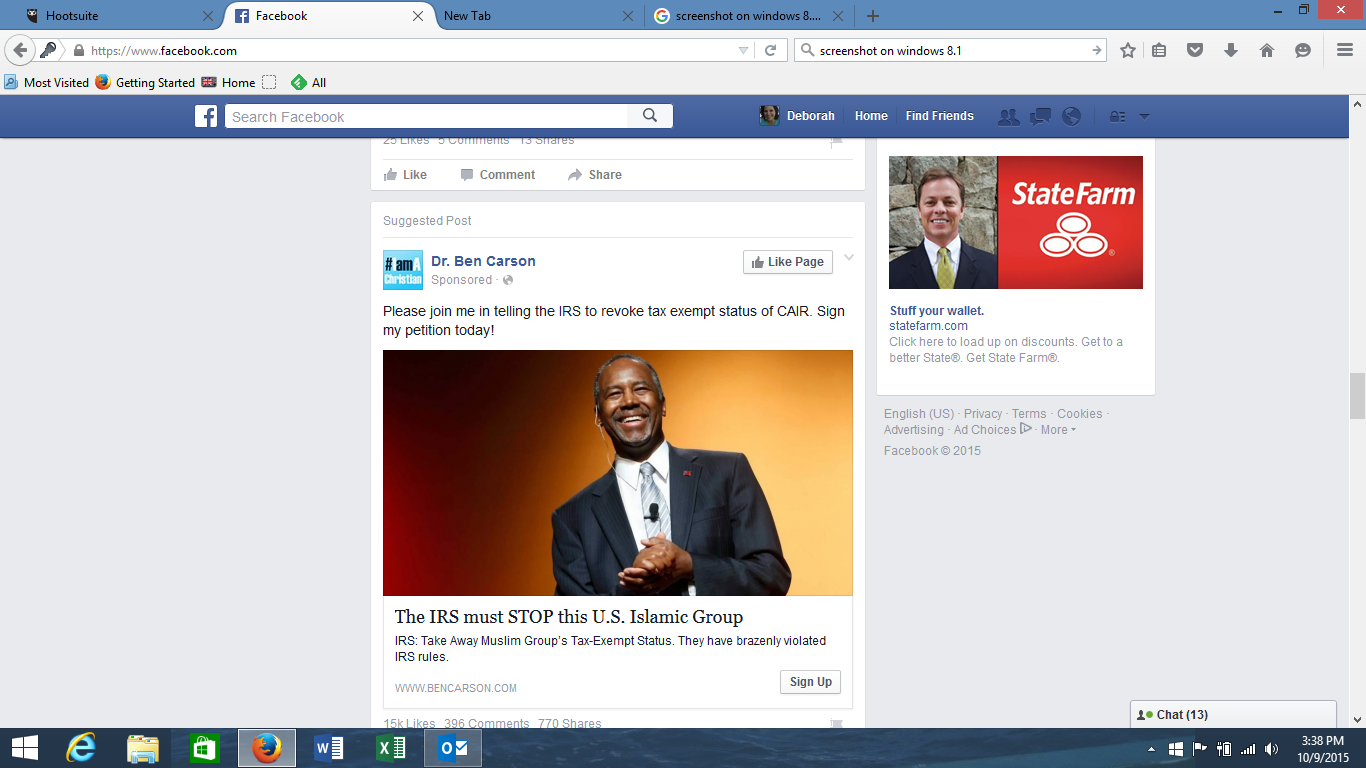
Like this one that appeared last week on my Facebook timeline:

Ben Carson sponsored ad in my Facebook timeline

I had definitely mentioned Ben Carson in my status updates. In a negative way. I had shared several articles about his horrible “gun control caused the Holocaust” comments. I couldn’t believe that anyone, much less a person running for president, would be so stupid and so offensive.

And then the sponsored ad popped up. Obviously the algorithm “if that then this” recipe says something like “if a person mentions Ben Carson more than once in status updates, then show the support Ben Carson ad.”

But I am the exactly wrong target. I don’t like Ben Carson and what I have been saying about him is not supportive. This sponsored post is a #fail as they say on Twitter, and a waste of the campaign’s money.

Don’t let algorithms fail you!

Automatic advertising has its pitfalls. But is the problem the algorithm or the person that makes the recipe for the algorithm? I suspect it’s a bit of both.

There are at least three steps to successful advertising by algorithm:

1. You have to understand how algorithms work

Advertising algorithms don’t do nuance. They can’t judge emotions–negative or positive. They can only scan for keywords and then follow recipes.

Plus, each search engine or social network has its own rules. Apparently for Facebook algorithms, budgets have a lot to do with how and when your sponsored content shows up. Read “The Importance of Understanding Facebook Algorithms, Part 1.”

2. You have to provide strategic guidance 

Before you launch any advertising, including online advertising, you must have a strategy in place. You need to define your target audience and be as detailed as possible. You need to define your objectives. You must understand what you want to accomplish.

3. You have to measure

And with online advertising, especially when you are relying on computer-generated algorithms, you have to measure. You want to understand your outcomes.  How did your ads do? What kinds of people clicked and did they take any other actions? (It’s always about the metrics.)

What would you add? Do you have resources to share about algorithms? What’s been your experience with algorithms in advertising? Successful or not so much? Please let me know. And if you want to discuss your advertising or communications strategy, get in touch!


image_pdfimage_print

5 communications lessons from The Great British Baking Show

If  you haven’t been  watching PBS’  The Great British Baking Show (which is called the Great British Bake-Off in the UK, where it originates), you are missing out on one of the most charming competition shows out there. Each season begins with a baker’s dozen contestants, who are asked during each episode to complete three tasks: a specific type of baking task  (cookies, pies, sponge cakes, etc.) , a technical challenge, and lastly, a “signature bake.”  Their “bakes” are judged by Mary Berry and Paul Hollywood, who each week choose a star baker, who has distinguished him/herself that week,  while also asking one of the contestants to leave. At the end of the season, only one contestant will remain.

1. Focus on form AND function

During the “Biscuits and Traybakes” episode that aired this past Sunday, the signature bake challenge was to create a beautiful tower made of biscuits. The tower had to measure around 10 inches and be creative, using different types of biscuits. Frances, who has been distinguishing herself for her creativity during the previous weeks, had a bad bake–her tower of biscuits collapsed right before the judging, prompting Mary to tell her that the “brief” was to build a tower and that it didn’t matter if her biscuits were tasty or her idea creative.

It’s not enough to look good or to be very creative, if the communications vehicle does not fulfill its mission. We’ve all seen beautiful websites that don’t have the correct information or that are difficult to navigate (which is what UX/UI tries to correct). This is why overly creative ads that don’t “convert” are a waste of money.

2. Technique and precision matter

Every episode of The Great British Baking Show has a technical challenge. The “Biscuits and Traybakes” episode required bakers to create tuiles, a delicate French cookie. A lot goes into creating tuiles–the batter must be of a certain consistency, you  have to be careful to not over or under bake them, and they are very delicate, so you must know how to handle and shape them properly.

The lesson for communicators is simple: you can’t rely on creativity alone. You have to learn the craft too. And you have to be precise with what you want to achieve.

3. Consider who you’re baking for

During the show, it’s clear that the contestants have to win Mary and Paul’s approval. It doesn’t matter if the contestants have been baking for years and their families love their stuff, if Mary and Paul don’t think it tastes good or it is not properly baked.

The audience matters. How sophisticated are they? What are they looking for? What will appeal to them?

4. You have to bake a lot of cookies

Baking well takes both knowledge and practice, but especially practice. The more you bake, the more you know what works and what doesn’t. You learn how to judge whether something is baked enough. You figure out your own shortcuts or how to switch up a recipe to make it taste right.

Experience matters in communications.  That’s not to say you can’t try new ways of doing things, but only that you can do it better if you’ve been doing it for a while.

5. You have to taste it!

During the “Pies” episode, contestants were asked to bake a fruit pie. One of the contestants, Ali, found fruit pies so disgusting that he didn’t even bother to taste the filling for his own apple pie. When tasting the pie, Paul reminded Ali that it is a must to taste your food. Ali was voted off  the show  because his pie didn’t taste good (and he had a couple of other technical issues too).

Perhaps we don’t actually taste stuff in communications, but we do have to understand what is going on with our “ingredients” and our “bake.” We have do some research to understand what our audience wants and what is important to communicate. And of course, we measure: we look at the results for a campaign or at the Google Analytics for a website.

Do you watch this show? Would you add anything else? Let me know in the comments.

image_pdfimage_print

And on to Plan C

Last week, my “new” laptop was in the shop. Apparently, the hard drive was failing and I couldn’t start up or use the computer in any way. I had already deployed my Plan B– using my old laptop (which is really ancient by computer standards). Then, on Friday morning, the old laptop spontaneously decided to shut itself off.  I turned it back on, and after a couple of minutes, it turned off again. Suddenly, I had no way of sending out a document I had to send or finish the blog post I was writing (it is in the drafts, and will be published soon).

Now what? I hadn’t heard back from the repair people to let me know what was wrong with the new computer, so I didn’t know if it could be fixed or how long it would take.

What could I do until I got a working computer back? Develop a Plan C.

Where could I access a computer? There’s always the computers at the library. In a pinch, that would do. But not as a real solution. First of all, you can’t be there for unlimited hours and there’s no privacy.

Then, I decided to look up computer rentals (using my smartphone).  There are several companies that will rent you computers and AV equipment. For a daily/weekly/monthly fee they will ship you a laptop that has Microsoft Office and boom, you are back in business. It’s not cheap, but it is certainly better than losing business because you can’t work.

Knowing the option to rent a laptop was available, I felt more in control. Then I remembered my former Plan B mini-laptop from a few years ago when I had a similar problem. I dusted it off, and started it up. It needed updates, but I was able to at least access the Internet on a bigger screen than my smartphone.

By the end of the day on Friday, the computer repair people called to let me know what was wrong. By Saturday I would have my computer back, with a new hard drive installed.

The moral of the story is simple: you must have backup plans. Not just Plan B, but Plan C and maybe even Plan D. You never know what can happen, especially with technology. A few weeks ago I told you about how Verizon cut off my cable and Internet. Plan B then was the smartphone, and Plan C was the library.

Having two computers be down at the same time has made me re-think my technology needs. Here are my new resolutions:

-Find an IT person to be on call for me. For years, I had a techie friend who would help me out, but that’s not a solid solution.

-Backup files regularly. Always. For the record, I did do this, but not as conscientiously as I could.

-Get another computer. You must always have a secondary option, especially if like me, you work for yourself and your work requires a computer.

It’s going to take some time to get everything back to normal, so if I haven’t written you back, be patient or write me again!


image_pdfimage_print

Guilty appeal

A couple of weeks ago I went into a small local specialty store that does not get a lot of foot traffic. The store sells lots of expensive gift items, and a few lower cost items such as cards and candles. I needed to buy a greeting card and like this store’s small but unique selection. I found what I wanted and when I went to pay the store owner, she asked me, quite pointedly, “that’s it?” Then she started asking whether I wanted to look at the handcrafted candlesticks and other gift items.  Her remarks made it clear that she needed more business and that my one $3 card was not going to cut it.

She was trying to give me a guilt trip.

If you look up the term “guilt trip” you will come up with several psychology-based articles such as  “7 ways to get out of guilt trips”, which define what a guilt trip is and why people use it. Basically, people use guilt trips in an effort to control behavior. Although guilt trips may reach their mark, they often cause resentment and anger toward the “guilt tripper.”

And I definitely felt resentment when I left the store. On the one hand, I felt bad for the store owner and wondered how she was going to stay in business. On the other hand, I felt angry since I had specifically gone to this store to buy a special card and this woman seemed to think that it was my responsibility to spend more than a few dollars to help save her business.

But is the guilt trip an effective strategy?

This got me thinking about how some charities –specifically those dealing with hunger, homelessness, and disaster relief– use guilt as an appeal for donors. These charities generally intend to appeal to your feelings of guilt for having access to comfort and food while others, who are much less fortunate, starve and suffer.

I am sure you remember the TV commercial for a children’s charity that would show pictures of starving children in Africa, often focusing on their distended stomachs and the horrible conditions around them. We were told that we could ease the suffering simply by sponsoring one child for the price of a cup of coffee a day. The underlying message was clear:  you should feel guilty buying your daily coffee when that money could save a child’s life.

Do you feel manipulated by these type of appeals? Or is this appeal to your feelings of guilt an effective way to break through the clutter and inspire action (a donation)?

Guilt trips have consequences

Guilt trips are effective in forcing action (after all, how many parents have used the line about starving children in Africa to get kids to finish eating their meals) but they may have negative consequences. Perhaps you stop feeling guilty once you’ve made a donation and then never donate again. Or perhaps,  you resent being made to feel guilty and you ignore the appeal altogether. In some cases, an appeal to guilt has been so many times that the audience has become jaded.

What’s the alternative?

For charities, an alternative is to emphasize how helping is a benefit to the donor. This way, the potential donor is not doing something out of guilt, and therefore feels good about his or her act. As a bonus, there’s no chance that the donor will feel resentment afterward.

Have you used the guilt trip as a marketing tool? Why or why not? And if yes, how did it work for you?

P.S. As I was writing this post, I got an email donation appeal that started with these words (emphasis mine):

In this moment when we are bombarded by shocking images of refugees risking their lives in search of safety, we must do all we can to help.

I know this because I have seen the fear in the eyes of refugees as they describe fleeing their homes in the dark of night.

I have sat with refugees as they shared their stories of being resettled in my home state of Ohio, and elsewhere in the U.S., overcoming language and cultural barriers to live their lives with freedom and security.


image_pdfimage_print

Why you should pay attention to user reviews

From Yelp to Google to TripAdvisor, user reviews can be found easily when you search online for anything, whether it be hotels, services, restaurants and so on. In our social media age, everyone is a critic and has a forum. People are keen to share their experiences, whether it be to warn others about bad service or to express great satisfaction at how a product works.

It’s important for  business owners (and for organizations) to pay attention to reviews.  Here are four main reasons every business should be actively tracking and soliciting reviews:

1. User reviews identify weaknesses that businesses should address.

Essentially, reviews are customer satisfaction surveys. Perhaps it’s because we’ve become passive-aggressive as a culture, but people are more likely to air their complaints to a third party. So instead of contacting management, people will go on Yelp and talk about their experience. For example, if you run a hotel, and every reviewer on TripAdvisor complains about the air conditioning, that tells you that you need to address the problem ASAP.

2. User reviews help businesses  appear higher in search results.

Reviews are content, and the more fresh content, the better the search engines like it.

3. User reviews give businesses a specific reason to interact with customers.

Whether responding to a negative review or thanking a customer for a positive one, a review gives a business a way to talk to customers beyond the initial interaction or transaction.

4. User reviews can tell businesses more about what customers consider important.

What people choose to highlight when reviewing a business can provide invaluable consumer insight. What types of things are most users praising or complaining about? What makes a user be enthusiastic about a business?

In sum:

Businesses that don’t track customer reviews are losing valuable insights about how they are perceived. Business that don’t respond to reviews are stating that what customers say doesn’t matter, and will miss the chance to improve.


How do you handle reviews? Have you designated a specific person or department to track reviews? Does that same person or department respond to reviews? Please let me know in the comments how your business or organization deals with reviews, and what you have learned (if anything) from them.


image_pdfimage_print

Hidden benefits are not beneficial

It seems fairly straightforward: if you offer something, especially if it’s of benefit to your customers/members/audience, you should make it known. And yet, I would bet good money that you aren’t reaping the benefits from various companies and associations simply because you don’t even know what they are.

Case in point: I called my car insurance company today about renewing my policy. The very efficient and pleasant (almost shockingly so) customer service agent helped me out and informed me that with my policy came various discounts at car rental agencies, oil change shops, and even restaurants.

If you don’t know about it, it’s as if it doesn’t exist.

Say what? I had absolutely no idea. None. Zip. Mind you, I have been a customer of this company for ages. And in that time, not once has anybody pointed out that I could be saving  20%  on my car rentals or getting $25 oil changes.

Turns out that this insurance company is doing a very poor job of showcasing these great perks. Which leads me to wonder why it bothers negotiating these deals with vendors if it isn’t sharing them with customers.

Hidden benefits or perks don’t benefit anybody.

Your customers/members/associates should understand why they do business with you, in other words, what is in it for them.  If they don’t know what benefits are derived from their association with you, there’s no reason for them to stay.

Do you know what benefits you offer?

Right now, answer this question: what are the top five reasons that made your customers/members do business/become affiliated with you? These are your primary benefits, and should be absolutely, 100% obvious.

Are there any secondary benefits? Are you offering special discounts or deals like my car insurance company? Are your customers entitled to anything special such as annual policy reviews, information sessions, special access to museums or cultural events, etc.?

Benefits don’t communicate themselves!

In order to maintain your customer/membership base, you must communicate all of the benefits you offer.

Don’t just assume your audience knows.  Audit your marketing materials (website, social media sites, printed materials, enewsletters, etc.)  to see if you are letting your customers/members know what’s in it for them when they do business with you. Survey your people to see what they know about your offerings, about why they do business with you.


image_pdfimage_print

When you lose your internet service…

I meant to post earlier in the week. However, Verizon “inadvertently” cut my FIOS line–so I had no TV or internet Wednesday into Thursday. Yes, this is a first world problem. Regardless, it had to be resolved, which involved the thing I despise the most in the world: calling Verizon customer service.

And it was just as bad as I feared. First you have to get through a phone tree (I can’t stand talking to machines). And then I got disconnected. Then, when I called back, the phone tree was stuck on whether I had power at my location or not. Thanks Verizon, for thinking I am that stupid that I would think that without electricity I would have working TV/internet. On the third try, I went for the Spanish option, from which I was able to finally speak to an agent (whose command of Spanish was not the best as he was versed in Spanglish more than Spanish).

To make a long story short, after more than 24 hours without service and after several calls to support, my FIOS is back on a temporary line that will eventually have to be buried (meaning I am still not done with Verizon).

I work from home, so having internet access is essential for me.  Yes, I have a smartphone so I wasn’t entirely disconnected from the world wide web, but try proofreading a brochure on your smartphone. Not so easy.

The only positive from this fiasco is that it sparked this blog post. Here’s what I learned from losing my internet service:

1.The measure of a company is how it responds to customer problems. Verizon does not do well on this measure. Verizon, like most companies, is fine as long as you don’t have a problem.  Verizon makes it very hard for customers to talk to customer service agents. It makes customers run around in circles: repeat information, navigate phone trees and so forth. I lost a whole day of service PLUS more than an hour getting someone to help PLUS using data on my phone PLUS having to go somewhere to be able to access the internet to do work PLUS waiting during a three-hour window. If I call to request a credit, I may be compensated for the service loss but not for my time and certainly not for the aggravation. I am sure Verizon is betting that I won’t want to lose more time on this, and it may be right. As I said before, I despise calling Verizon’s customer service.

2. Monopolies like Verizon have no incentive to be customer-centric and they don’t advertise or promote their customer service. If you notice, all FIOS advertising is about what great speeds you will have or any other benefits of having WORKING service. There’s  no mention of the great customer service that accompanies this “super-fast” internet because there is none.

3. Some companies provide better customer service via social media. Verizon does not. Several years ago this was not true. You could get better, faster service from Twitter since @verizonsupport agents seemed to be more empowered than those on the 1-800 number.  Now, if you complain on Twitter, Verizon reps will quickly want to move you over to direct message so that they can give you a link to report your problem. Agents on @verizonsupport seem to have little or no ability to actually help or intervene in your favor, unlike @deltaassist, which has the ability to rebook your flight, etc.

4. The problem is with company policies not with employees. It’s been my experience that people want to help, but they are forced to follow company policies and procedures, which are not customer-friendly. The technician that came to my house was far more helpful and on the ball than the agents on the 1-800 line. He was empowered to do what he had to do to fix the problem, whereas the agents in the call center were forced to call other departments and work within constraints.

5. You must have a “plan b” or “plan c.” If something fails (you could lose power, or your car is in the shop or any other unexpected problem), you have to find a work around. In this case, my county libraries all offer wi-fi, and have desks with power outlets. That was the way to get some work done for me.

And lastly, on a personal note:

6. I have to try to stop sweating the small stuff. I get upset because I expect things to work and work well. And they often don’t.  Yesterday, I was reminded  that our time on earth can be very short and you just don’t know how life will turn out, so perhaps worrying about Verizon is a complete waste of time. I had my annual eye doctor appointment, and the usual optometrist was not there. I was shocked and very sorry to learn that she died suddenly after an aggressive illness. She was around my age. She was a very nice person and I always enjoyed chatting with her. The doctor told me she had been very healthy and health-conscious, but this illness came out of nowhere. She was gone in a matter of weeks. Rest in peace Teresa, you are missed.


Enjoy your Labor Day weekend!  How did we get to the last weekend of “official” summer  so fast? Sigh.

image_pdfimage_print

Do this one thing!

You have to do PR if you want to get new clients!

You have to have an optimized website if you want to get new customers!

number 1 by Jon Jordan on Flickr

You have to do content marketing if you want to get new leads!

And most recently,

You have to try Periscope to get some exposure!


In the new world of marketing communications, there is a growing array of standard and innovative possibilities for getting the word out about your business.

From the pre-Internet era we have good old advertising/public relations/marketing, including the use of print materials, broadcast, outdoor, direct mail, etc.

From the Internet-era, we have websites and email marketing.

From the social media-era, we have content marketing, and a seemingly endless stream of networks (Twitter, Pinterest, Instagram, and so forth) and video in short format (Vine) and in long format (Periscope). And I am sure as I write this, something else is bubbling up to capture our short-attention span.

Here’s the thing: all of these work. They work differently, with different audiences and with different levels of “engagement.”  But the uncomfortable truth is that no one thing will get you leads/customers.

Back in the old days, we had a concept called “integrated marketing communications.” It posited that in order to be successful, you had to use a variety of marcomm tools and make sure they were playing nice with each other.  For example, if you were using sponsorship and public relations, the PR folks would know what you were sponsoring and the sponsorship folks might in turn get a bit of PR for the sponsorship. You know, everybody working together toward a common goal.

Now it seems that people want a shortcut. They want to try the one thing that will “guarantee” results. Everybody seems to be lurching from one platform to the next, one tactic to another.

If you want to achieve results from your marketing communications efforts you are going to have to stop being tactical and start being strategic. Stop thinking in terms of doing one thing to get audiences interested today and start thinking in terms of objectives and actions you want from said audience.

You can’t do just one thing.


If you need help figuring out what your communications efforts should be, contact me today! Let’s talk.

image_pdfimage_print

It’s a 2for1 blog post

There’s been two blog post ideas floating around in my head, so I thought I would combine them since they are both short.

Details please!

A few weeks ago, I saw a query from a woman to a group we’re both in. She was asking about “affordable” meeting space that would allow her to charge for admission. Predictably, the questions starting rolling in: How many people would she be hosting? Would she be serving food? And from me, what did she consider affordable?

Her question was fundamentally flawed because she did not provide enough detail.

Imagine if before asking a vague question, this woman had taken a few minutes to think about what is necessary in booking a meeting space (you know, those pesky details):

  •  Number of attendees/space needs
  • Location
  • Budget
  • Amount of time needed
  • Schedule (date and time)
  • Ability to charge attendance
  • Catering (needed or not)

She would have saved time (hers and ours): getting better suggestions and fielding fewer questions.

Next time you are looking to get information about anything, take a few minutes to think about the details that may be relevant. Make it easy for others to provide you with the information you need.

It’s all about him!

Saw this on Twitter:

2015-08-18 10.57.40Although it’s become acceptable to use the plural for gender neutrality (I still prefer his/her because plural is plural), if you know the gender (male in this case) it is perfectly OK to use a gendered pronoun (his not their). It’s worrisome that people are so intent on being gender neutral (which is good) that they forget that gendered pronouns can be used appropriately.

That’s all folks. Catch you soon and let me know if you have any documents that need some copy editing.

image_pdfimage_print

Do you have a Twitter strategy?

I follow more than 1,300 accounts on Twitter. Some of them are purely news sources and some are people I know “in real life.” Some are journalists and others “social media experts.”

Sand sculpture by Rosaura Ochoa via Flckr

Since I spend a good amount of my day on Twitter, I see a lot of tweets. Many of those tweets are interesting or funny or offer good advice. However, some tweets make me wonder if the person/account has ever considered why he/she is on Twitter. I see constant check-ins and bitter complaints about spouses. I see random quotes and people earning points for some action (usually checking in). I see people obviously brown-nosing (“Store X is the best, super customer service). And just today I saw a tweet about someone’s menstrual cycle (I wish I were kidding).

Get strategic.

Big brands probably have a written and codified Twitter strategy that is part of their larger content strategy. But if you are a freelancer, small business owner or just you, you may not have a “content strategy” much less a Twitter strategy? But should you?

If you want to get more out of Twitter, yes, you should develop a simple but effective strategy.

Here’s how to develop a Twitter strategy:

  1. Decide what you want to achieve on Twitter. This is also the answer to “why am I here?” Perhaps you want to make business contacts or you want to learn more about a subject or you want to promote your writing. Whatever it is, write it down.
  2. Now, figure out  your audience. What kinds of people or accounts are likely to have the type of information you are interested in? Who on Twitter would be interested in your stuff? Can you describe a group or groups of people that would be your audience? For example, if you are a knitter and sell stuff on Etsy, your audience would be other knitters, people interested in crafts and so forth.
  3. What defines success for you on Twitter? Do you want to have a large following? Do you want to be an influencer? Do you want to meet like-minded folks in person?

By thinking about these issues, you will start being more focused or purposeful in your tweeting.

Now, get tactical

Tactics are what puts your strategy in motion.

  1. Engage. See someone asking a question? Respond! Find somebody’s tweet useful/inspiring/interesting? Retweet!
  2.  Become a content curator. Find sources (Twitter accounts, blogs, websites) and follow them. Collect and share the most relevant information for your audience (see above).
  3. Join/follow selected Twitter chats. There are so many on a variety of topics, and folks that participate in those are folks that are interested in the same stuff as you are.
  4. Use lists. Twitter gives you the ability to put accounts into lists, and then, when you use a Twitter client such as Hootsuite, you can put those lists into their own column. This way if you have a list of “Fiendish knitters” you can make sure to see what those crafters are up to.

What am I trying to accomplish?

Of course you will have the occasional “not on message” tweet. You are a person with a life and you want to share your interests or things that happen to you. But if this is all you tweet, you have a problem, and you are probably not seeing any results from Twitter.

So, perhaps before you tweet anything, you should ask yourself : What am I trying to accomplish by sharing this?

Let me know: do you have a Twitter strategy? Can you share it?

image_pdfimage_print

Contact us today to learn how to improve your marketing and communications.