5 keys to successful content marketing

Yesterday, the PRSA-National Capital Chapter hosted a panel on content marketing and public relations. The panelists–Michael Laxineta (Custom Briefings), Bruce Namerow (Interactive Strategies) and Anne Holtz (Home Innovation Research Labs)– did a great job of explaining what content marketing is, how it works and how to make it work better.

Michael Laxineta said he believes that the “PR profession is the original content marketer.” He says that 91% of business-to-business marketers are using content marketing, and that the biggest challenge is providing engaging content. Bruce Namerow said that content drives anything, and that brands now are their own publishers.

Content marketing has many benefits, including brand awareness, nurturing leads and building relationships. Anne Holtz said that prior to embarking on a content marketing strategy, Home Innovation Research Labs was doing great stuff, but people did not know about it.  Having a strategy in place has helped get traffic to its website.

In order to develop a successful content marketing program,  you should consider these five key steps:

1. Make sure that your content marketing is in line with both your business and communications goals.

2. Understand exactly who your audience is and what information they need.

3. Do keyword research so that you are using the terms and keywords people actually search.

4. Personalize the content to your audience needs. It is not about reaching everyone but about reaching your niche with the information they need.

5. Make sure your content is mobile-ready.

Perhaps content marketing is just a fancy new term for what we used to call integrated marketing communications, as my friend Karen Addis from Environics Communications said. Whatever we call it now, it is still smart to reach your audience with the information they require to build a relationship with your organization or to buy from your business.


Why you need to be extra careful with your email marketing

Regardless of all the stories about email being dead, it is still around and it is still used for marketing purposes. Think about the amount of email you get every day. How much of it is personal (and by that I mean addressed to you from a real live person, whether it be to discuss weekend plans or the latest changes to the document you are working on)? I bet only a small fraction falls in the latter category.

What makes email marketing so effective is that it targets people directly and sends the messages into a place they are likely to be every day–their email inbox.  Successful email marketing is personalized and customized. Email marketing gives you the ability to address email  to individuals by name and send them the news, offers or other information that is relevant to them.

And yet, today I got an email with the following subject line: David, connect with [name of marketer]. Yes, you are personalizing, but you screwed up my name. I could have deleted it had I not recognized the sender.

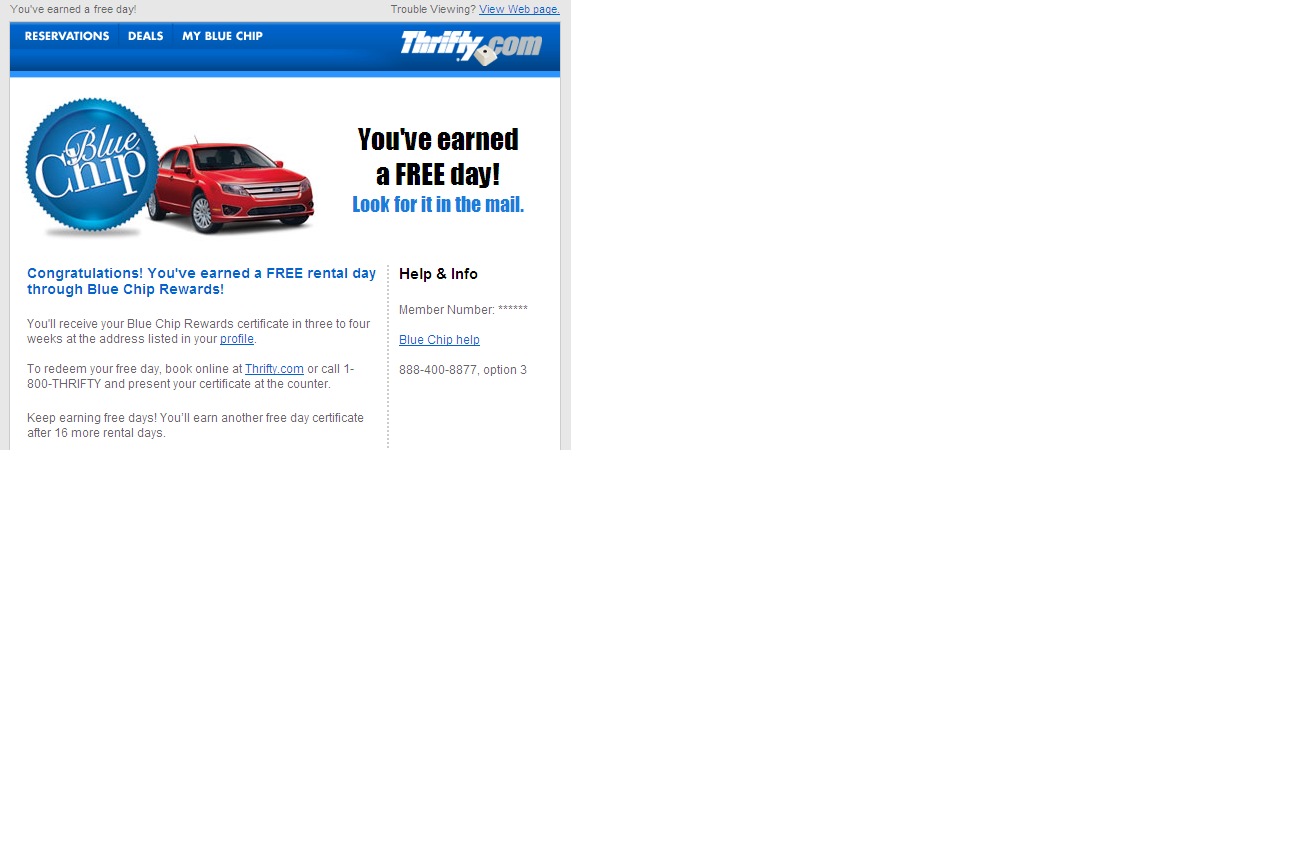
And yet, on Friday, I got this email from Thrifty:Thrifty 1

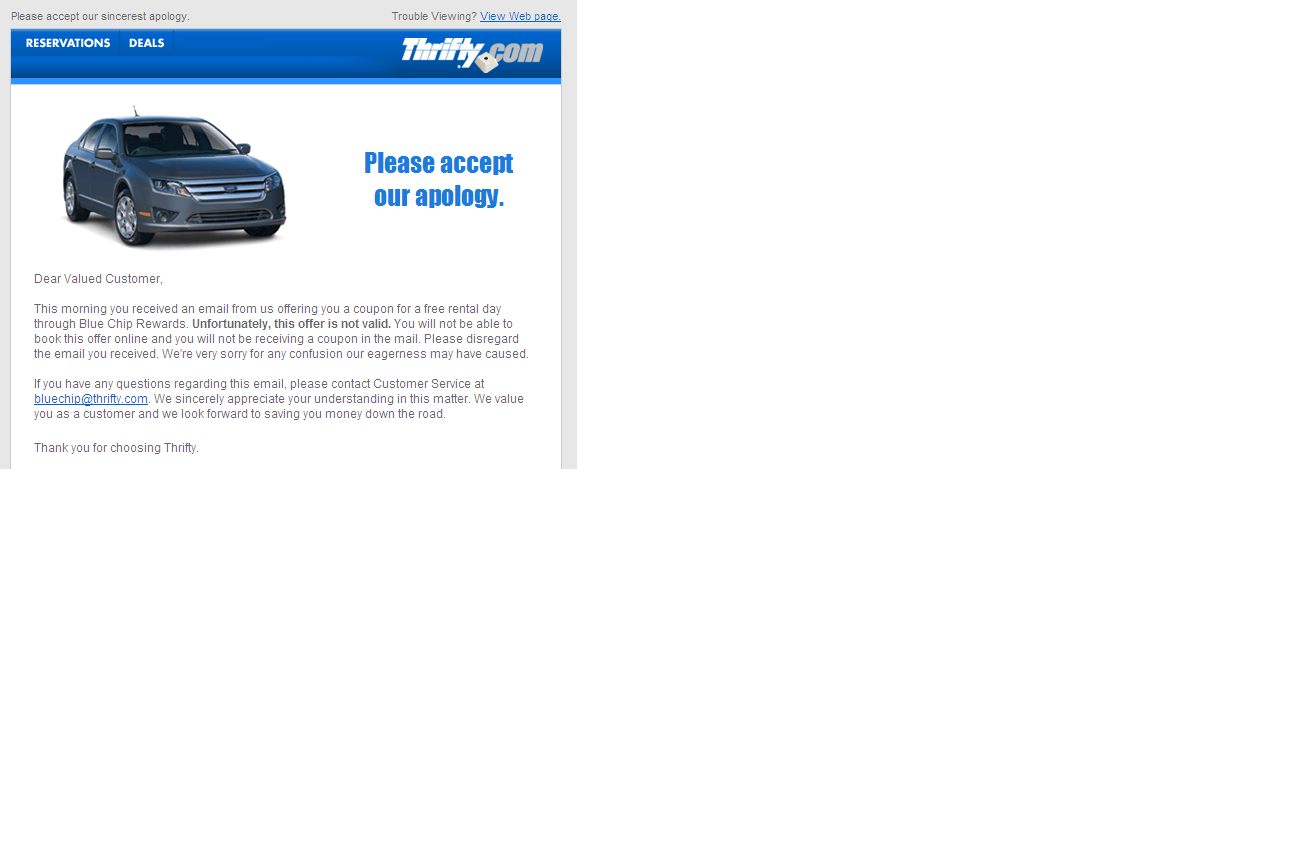
Then, on Saturday I got this one:

Thrifty 2I am not sure how many people got this email, but since I happen to rent a few times a year, I thought the first email was for real and an offer for me personally, even though I don’t have a Blue Chip account. The second email–addressed to “Dear Valued Customer”–did not make me feel valued at all.  Thrifty is now telling me that it screwed up and that the offer it  sent is not valid,without doing anything to compensate for the mistake.

Are you screwing up the goodwill?

How many times can you screw up and keep goodwill? The difference between screwing up in a mass advertising campaign is that it is impersonal. When you screw up on email you have addressed a client/customer/prospect directly and personally, you have to be more contrite. Since you have the ability to be personal, then be personal! And be more careful.

It is about opting-in. Don’t give them a reason to opt-out.

The reason that we use email marketing is because, generally, it is opt-in. That is, people have signed up to receive our messages and want to get them. There is goodwill. But if you fail to personalize, send out erroneous offers, or the wrong offers, you are jeopardizing  that goodwill and giving your list a reason to opt out.

Thoughts?


What your latest hotel stay can teach you about marketing

Have you stayed at a hotel recently? Did you enjoy your stay? If you didn’t, what was it that you had issues with?  Towels not fluffy enough? Housekeeping didn’t clean properly? Or my pet peeve, too much noise?  If you did enjoy your stay, what made it good? Helpful staff? Location? Great amenities?

Motel
Motel in Livingston , MT by Beyond Neon on Flickr

Your experience with the hotel is what makes you like it or not. Not the advertising and probably not the rate you paid.

Last year, I stayed at a chain hotel where the price was right, but nothing else was. I could hear the alarm of the guy next door to me (and his TV and everything else). The coffee in the “free” breakfast was terrible. When I complained and asked for a different room,  they did accommodate me. But the problem wasn’t the room itself, it was the hotel’s cheap construction. I will never stay there again.  On the other hand, over New Year’s I stayed at a boutique hotel. There were only a few rooms per floor. The building was old and solidly built. Plus, it was in a great location, quiet and comfortable. I would go back.

Marketing can get you to book a stay, but you won’t be coming back if you had a bad experience. And in this social media age, you most likely will share your experiences on a rating site like Trip Advisor or Yelp.  If you have questions or concerns, you  may go on Twitter or Facebook.

Marketing is important, but so is the customer experience. You can’t succeed in business if you don’t work on both. Too many companies spend extraordinary amounts of money trying to get you to buy something, but then don’t expend any effort once you’ve made your purchase.

With service products, like hotel stays and air travel, experience matters even more because there is no tangible item that you have bought. All you will be taking home are the memories of the experience. The flight went smoothly and you got to your destination on time? That is either a good memory or something that you don’t think about again. But if you got to your hotel and there were dirty linens on the bed and a non-functioning air conditioning unit, not only is that a bad experience, you will remember it.


Too much info or too little?

Yesterday, I got two emails from two completely different organizations. Both had too little information but one was paragraphs long and the other not even a sentence.

Let me discuss the longer one first. It was an email from an organization that is folding. They email was an invitation to a farewell dinner. It included all the necessary event information (date, place, time) but left out one crucial piece of information: why the event was necessary in the first place. Why are they closing shop? Mystery has its place, but not in this type of email. Just come out and say it! I am not sure if the group is finished because of poor attendance, lack of leadership or orders from above.

The second email was even more of a head-scratcher.  It came from an organization I was not familiar with, and had the following subject line: “Focus on your business-not your database.” In the body of the email there was nothing but the organization’s email signature (not even a website address!). Nothing at all. Attached, is a brochure with what I presume is more information.  There are at least three things wrong with this:

  1. The subject line makes assumptions: it assumes that it is bad to focus on your database or that I am focusing on it instead of my business (huh?).
  2. There is no context for the contact. Read my post “How to write a contact email.”
  3. In this day, smart people only open attachments from trusted sources. Since this source did not even bother to write a couple lines identifying itself and its business and its reason for contacting me, why should I bother opening the attachment?

You can provide too little information. In something like the first case I talk about, this may lead to a follow up from your contact. I know who the organization is but am lacking some information I am interested in knowing.  In the second case, the lack of information makes me distrust the sender and want to delete the email.

The key is to provide ENOUGH INFORMATION for a person receiving your message to make a decision.

Your thoughts?


It’s only new once

You can’t call yesterday’s news new. In fact, you probably can’t call it news either. And yet, it has become a habit for some marketers, most notably those on Twitter, to use the word “new” or even worse, the word “breaking” to set apart their content. Now, if something is truly new or breaking, then that’s fine, but keep in mind that calling something new or breaking is a one-time-only proposition.

News Shop
News shop by Cyberslayer via Flickr

Once you have called something new or breaking, you can’t do it again. Why? Here are three reasons:

  1. It is false advertising: it is no longer new.
  2. It undermines your credibility: you are trying to get me to believe something that is not so.
  3. It’s a cheap tactic: is this the only way you can get attention for your product, service or idea?

If I see a Twitter stream replete with the words new or breaking, it better be from a wire service, newspaper or news broadcast. A post that you wrote two weeks ago is not new. An idea that you tweeted out last week certainly is not breaking.

Remember it’s only new once, everything else can be classified as gently used or old or even outdated!


How to write a contact email

If you have received any type of contact email, you know there is a way to do it and a way not to.  Just this week I received a contact email that made me realize lots of salespeople don’t know how to do it.  The email I got was this:

Hi Deborah:

I’m working with the [company name] sales channel, and my client requires the assistance of a company specializing in “Communications Audits”.

Kindly drop me a line to discuss (my phone number is provided below).  Thanks,

[Email signature]

This email followed a voice message that went like this:

Hi Deborah, My name is X , a consultant working with the sales channel (…) and [my client] is inquiring about a communications audit. And I’d like to talk to you about it, how does it work, relative to their sales channel, it would be very lucrative to your business. …

The consultant seems to assume I understand what “the sales channel” is supposed to be. He is also looking for “communications audits” relative to the sales channel. And lastly, he is telling me it would be lucrative to my business.  There are two things going on in the contact, and they are at odds with each other: looking for a solution for a client and offering something to me. Which is it? Neither is clear.

I asked for clarification as to what exactly he was looking for, and this consultant suggested having a 15-minute conversation. When I said I needed more information to see if there was a fit, he repeated what he had told me. I then wrote back saying I thought there wasn’t a fit. To top it off, I got this email back from him:

I’ll gladly give you appropriate details if we were to connect.

Surely you’re not too busy to grow your business and frankly, if you are – delegate to as a sales rep.

You’re not too important to talk to me; I deal with Presidents of companies with revenues exceeding $100M.

In the end, this person is really trying to sell ME something, which is obvious since he can’t tell me what problem his client is having that he thinks I can help with.  What he really wants is to have a connection with me. And he thinks that by insulting me and assuming things about me, I will want to talk to him (not to mention that he has grammatical challenges…)

If you want to have write a successful contact email, do not follow the example above. Here is what you should do instead:

1. Start with being clear on the purpose of your contact. What you are looking for. Are you looking for a quote? A description of services? A location?

2. Tell the contact how you found him/her  and/or why you are contacting him/her.  For example: I am looking for a general contractor, and I came across your name in the XYX directory.

3. Provide details that may be relevant. Don’t assume that the person understands everything you are saying. Using the example of the general contractor: I am looking to add a powder room to the first level of my two-level house. Currently, I have two bathrooms upstairs. I think there is enough space on the first level to accommodate this change. I am not sure if the plumbing can be worked in.

4. Ask specific questions. Are you able to do this service? What do you charge? What other information do you require?

5. Close nicely and provide contact information: Thanks for your attention and please contact me either by email or by phone at xxx-xxx-xxxx.

6. Before sending, make sure your spelling and grammar are correct. Emails that are full of typos and mistakes make you look unprofessional.

Realize that you may not always get a response. That’s OK. And if you do get a request for clarification, clarify! You may have questions, and the contact may have questions. Don’t assume that you both know everything.

Finally, don’t do what the guy in the contact email to me did: say you want one thing, while meaning something else. People see through that and it makes you look bad.

Thoughts?


Wishing is not a marketing tactic

Several weeks ago, I started getting a weekly newspaper in the mail. It was a supposed to be a four-week free subscription to thank me for some volunteering I had done. The enclosed note said that they hoped I would consider subscribing.

I would consider subscribing, but I haven’t been given the chance. I keep getting this newspaper, even though it has been more than eight weeks (twice what was originally offered) and never once has a subscription card come along with it. I guess they are wishing I call them and say “please charge me for the paper you are already sending me for free!”

Wishing is not a good marketing tactic.

Gran blows out her candles on her 80th birthday cake
Gran blows out her candles on her 80th birthday cake by Ben Sutherland on Flickr

Instead, ask for what you want or give potential customers a pathway to becoming paying customers. In this case, the newspaper could send me a card saying that they hope I have enjoyed my free trial subscription, and if I would like to continue getting this newspaper, then please send a check in the enclosed envelope or call some phone number with my credit card information.

We see this with many other situations. Another common example is failing to ask for referrals. Does your hair or beauty salon ever ask you specifically to refer people? They probably wish you did, but they don’t make it easy or worth your while. Say they said to you when you were checking out: We hope you like your new hair do. Perhaps you know someone else who wants a new haircut. If you do, we have a referral program. Just tell your friend to call us the number on this card, and we will give you a discount on your next service.

Sometimes you have to ask very specifically for what you want. A few days ago, I read that the tweets that get the most traction are the ones that have an ask in them: please retweet,  please help, please donate, etc.  You can’t wish for things to happen…you have to make them happen!

Thoughts?


PR for PR people

You’ve heard the saying about how the cobbler’s children go barefoot. It seems to me that this is especially true for PR agencies and practitioners. They don’t seem to get that they need to think about their image and their relations with their public. They are in PR but don’t practice PR for themselves.

Recently, a large PR firm had layoffs. They were not publicized as most companies like to keep this information quiet.  I happen to have a connection to some of the people that were laid off, and I heard that the layoffs were not handled nicely (or a nicely as being told you are losing your job can be handled). The people who were laid off were given just a few minutes to collect their belongings and leave the office. They were only given two weeks severance.  One of them did not get a chance to take her personal stuff with her, and the agency “lost” it. In short, they were not treated very well.

What’s astounding to me is that a PR agency that is in the business of making clients look good can do things that make itself look bad. Why would you not handle a layoff in a more caring and thoughtful fashion? Don’t you know that people have friends and friends have social media? Don’t you know that reputations depend on cultivating good feelings and trust?

And then there is all the questionable personal stuff that PR people do in business settings, like having incomplete or outdated LinkedIn profiles or using Twitter  to post automated horoscope listings. And then there are stories about PR executives that go on Twitter to rant and rave, and sometimes even post nasty comments about clients, as if nobody can see (and copy and disseminate) that?

PR people (and agencies) must learn that what they do–both publicly and privately– is open for scrutiny, and in a digital world, news travels fast and wide. Ultimately, public relations is about protecting reputation and helping build and protect an image. PR agencies and practitioners need to think about their own reputation and image, and act accordingly.


One quick fix that will increase your blog’s impact

Yes, this is really about making ONE fix, that should not take more than a few minutes, and that will make difference in how many people see your blog. It involves your sharing capabilities.

You must have sharing capabilities. That’s not even up for discussion. If you don’t, go add it right now. If you have a WordPress.org blog, then go do a search for “sharing buttons” in the plugins. There are several to choose from. My current favorite is ShareThis (and is what I am using, right there at the bottom of this post).  If you are on another platform, use your search engine to search for “sharing tools” or “sharing buttons” for your platform.

Most sharing tools are free, and most give you the options to share on the main social networks like Twitter, Facebook, LinkedIn and Pinterest. Some let you share to dozens of other networks. Choose the one that best suits your needs (and where your audience is likely to share and read).

If you already have sharing on your blog, I want you to go to your blog and choose a random post and hit your Tweet this/Twitter share button and see what comes up. Ideally, what should come up should be

“Title/ headline of your post”  (link to the post) via (your Twitter handle).

If what comes up does not have the title of your post plus your Twitter handle, you need to either adjust your settings or change your sharing tools. Some sharing plugins allow for the title of the post, the name of the blog or website, and the Twitter handle. That would be even better.

Many blogs I have seen in the past few days have sharing, but when I click to share I get these types of messages:

  • Reading [link]
  • [link]
  • Title[link] via [your sharing tool’s Twitter handle]

Without a title or headline, you are giving no reason for your readers to click on the link. Do you click on links with no subject? Probably not. Without a Twitter handle, you are not letting people know where the link is coming from.

So, go check it right now! This is truly a quick fix that will make it easier and better for your readers to share your posts, and therefore, increase your impact.


3 guaranteed ways to lose business fast

Sometimes you see stuff that makes you shake your head (or slap your forehead) and wonder how some people manage to stay afloat.

THE G.A.H. PERM FOREHEAD SLAP
THE G.A.H. PERM FOREHEAD SLAP by happy via on Flickr

Based on personal experiences in the past week alone, here are three guaranteed ways to lose business fast:

1. If you have a website, make sure it is lacking relevant information.

Sure, every business should have a website, but not any website will do. Websites should be useful if you want them to support your business.

I was looking for a restaurant in which to grab some lunch. I found several and checked out their websites. One place had a website that did not have the following: hours of operation, location, menu.  Guess what? I did not have lunch there.

2. Make it very difficult to do business with you (and easier to do it with competitors)

How many hoops do you want your potential customers to jump through? Five? Ten? Perhaps you are putting a few too many obstacles for your customers to climb through to get to you. These obstacles can be things like too many forms to fill, rules, not providing services your competitors provide, and so forth.

I wanted to get some catering for my workshop last week. I usually order coffee and pastries from a national chain, but that place was not nearby the location last week. I thought I would patronize a local place, so I checked it out. First, it took ONE week to get an answer back. Then, I was told that coffee could be provided, but the coffee urn would have a $100 deposit (meanwhile, almost all coffee chains have a portable cardboard coffee box that they don’t have to charge a deposit for). Oh, and they do not provide plates for the pastries. Guess what? I found another place to get some coffee and pastries.

3. Ignore your social media responses and/or your emails. Take your time responding if you do get around to it.

The thing about social media and in some cases email too is that it is a quick response forum. This is not the pony express or even the USPS. I don’t send a missive on social media expecting a response next week. I expect it today, or even sooner.

I wanted to refer someone some business, but did not have complete contact information. I tweeted and got no response. Even now, more than a week later, I have yet to receive any type of acknowledgement. I can’t send business to someone who either doesn’t care to respond or doesn’t understand how social media works. And then there is the case of the coffee shop I mentioned above. One week to answer an email about doing business with you? That is unacceptable. If you can’t answer emails or tweets, then I think you don’t have the time or the interest to do business with me.

Have you seen these classic business mistakes?